
A successful event is rarely the result of a single good idea. While guests may notice the stage design, entertainment, venue, or overall atmosphere, the real work happens much earlier. Every successful programme requires clear direction, coordinated resources, effective leadership, and continuous monitoring.
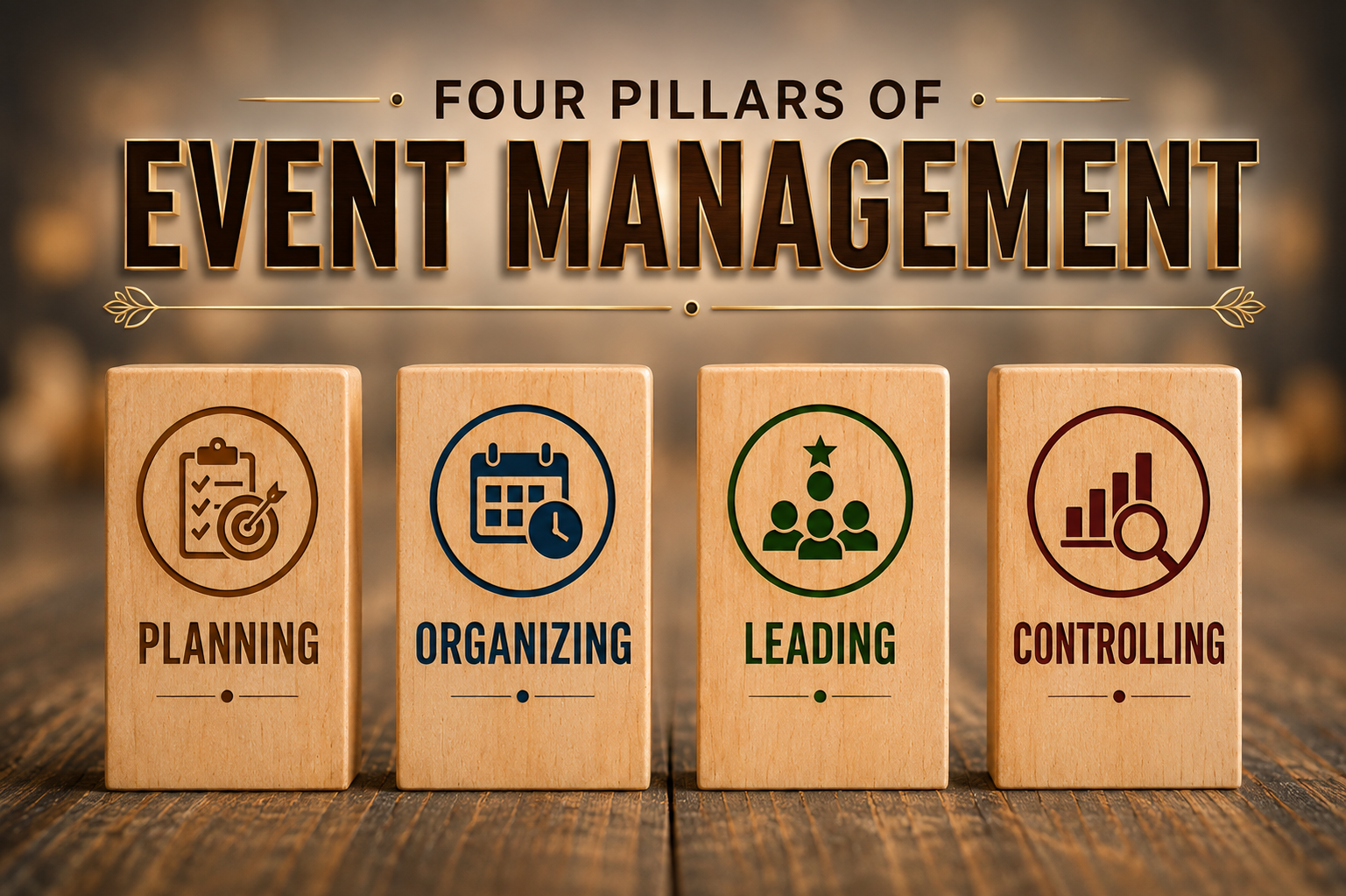
This is where the four fundamental pillars of management become relevant to event management: planning, organizing, leading, and controlling. Together, these functions provide a structured approach to managing an event from the initial concept to the final execution.
Each pillar serves a different purpose. Planning establishes the direction. Organizing puts the required resources in place. Leading brings people together around a common objective. Controlling ensures that the work remains aligned with the original expectations.
When these four areas are managed effectively, an event becomes easier to coordinate, even when multiple teams, vendors, stakeholders, and operational requirements are involved.
1. Planning: Defining the Direction Before the Work Begins
Planning is the starting point of every well-managed event. Before a venue is booked or a vendor is contacted, there should be a clear understanding of what the event is expected to achieve.
The first step is identifying the purpose. A product launch, leadership conference, annual celebration, dealer meet, or employee engagement programme may all involve different audiences and requirements. Without a clearly defined objective, decisions about the format, scale, budget, and experience can quickly become disconnected.
Planning also involves identifying the target audience and understanding what they should take away from the experience. This helps shape the concept, programme flow, communication, and other important decisions.
A detailed plan should also establish realistic timelines, financial boundaries, major deliverables, and potential risks. Instead of treating these as separate documents, they should work together as part of one management framework.
For example, a decision to include a large-scale production element may affect the budget, venue requirements, technical preparation, and setup schedule. Considering these dependencies early helps prevent unnecessary changes later.
A professional corporate event management company in Chennai should therefore begin by understanding the objective before moving into execution. A strong plan does not remove every challenge, but it gives the team a clear reference point when decisions need to be made.
Planning creates direction. Without it, even a creative concept can struggle to develop into a coordinated experience.
2. Organizing: Turning the Plan Into an Operational Structure
Once the direction is clear, the next responsibility is to assemble the people, resources and activities required to bring the plan to life. This is where an event starts to become more of a practical operation rather than an idea on paper.
Organization involves deciding what resources are needed and how they will be managed. Depending on the nature of the program this may include for example venue, production equipment, hospitality, transportation, registration, entertainment, security, décor, technical But aligning resources is only one part of the puzzle. Responsibilities must also be well defined.
A successful event usually involves several people working simultaneously. Internal teams, suppliers, venue representatives, technicians, client stakeholders, and support staff may all have different responsibilities. Without clarity, important tasks can be missed or duplicated.
This makes role allocation essential. Every team member should understand what they are responsible for, when their work needs to be completed, and who they need to coordinate with.
The best corporate event planners in Chennai do not simply manage a list of suppliers. They create a working structure that connects different functions and ensures that information moves efficiently between everyone involved.
Good organization also makes it easier to handle complexity. When responsibilities, timelines, and communication channels are already established, the team can focus on solving actual challenges rather than trying to determine who should handle them.
3. Leading: Bringing People Together Around the Same Objective
People deliver events. No matter how detailed the plan may be, successful execution depends on the ability of individuals and teams to work together.
This is where leadership becomes an essential part of event management.
Leading involves guiding the team, communicating expectations, making decisions, and maintaining a shared focus throughout the preparation process. It is particularly important because event teams often consist of people from different professional backgrounds who may not work together regularly.
A production team may focus on technical delivery, while hospitality personnel are concerned with guest experience. Vendors may be working according to separate schedules, and client representatives may have changing requirements. Leadership helps connect these different priorities to the larger objective.
Clear communication is one of the most important elements of this process. Teams need to understand not only what they need to do but also why their role matters to the overall programme.
Effective leadership is also tested when circumstances change.
A speaker may arrive late, weather conditions may affect an outdoor setup, or a last-minute request may require immediate action. During these moments, the ability to assess the situation, communicate clearly, and guide the team can have a direct impact on the outcome.
Professional corporate event management services in Chennai require this combination of coordination and decision-making. Leadership is not simply about giving instructions. It is about creating confidence, resolving challenges, and helping different teams continue working towards the same result.
A strong leader also understands when decisions should be delegated and when direct intervention is necessary. This balance allows the wider team to remain responsive without losing control.
4. Controlling: Keeping the Event Aligned With the Original Plan
Planning provides the direction, organizing creates the structure, and leadership drives the work forward. Controlling ensures that everything remains on track.
In event management, controlling does not mean restricting the team. It means monitoring progress and comparing actual performance with what was originally expected.
Timelines need to be reviewed to identify delays. Expenses should be monitored to prevent the budget from moving beyond agreed limits. Quality checks may be required for production, venue setup, guest services, and other important areas.
The purpose is to identify deviations early enough to take corrective action.
For instance, if a supplier is unable to meet a deadline, the team may need to adjust the schedule or arrange an alternative solution. If a production requirement exceeds the approved budget, changes may be required before the issue affects other areas of the programme.
During the event itself, controlling becomes even more immediate. The management team needs to monitor the programme, coordinate transitions, address operational issues, and ensure that the experience remains consistent with the planned objectives.
Experienced corporate event organisers in Chennai understand that monitoring should not begin only on the event day. Regular reviews throughout the preparation stage provide opportunities to identify problems before they become difficult to manage.
Controlling also continues after the programme has concluded. Reviewing feedback, performance, challenges, and outcomes can provide useful insights for future events.
The purpose is not simply to identify what went wrong. It is to understand what worked, what could be improved, and how future experiences can be managed more effectively.
How the Four Pillars Work Together
The four pillars should not be viewed as separate stages that exist independently.
They form a connected management cycle.
Planning determines what the event needs to achieve and how the team intends to reach that goal. Organizing brings together the resources and responsibilities required for execution. Leading keeps people aligned and responsive throughout the process. Controls monitor performance and help correct deviations from the expected outcome.
Consider a corporate conference. The planning stage may define the audience, objectives, format, and budget. Organizing then allocates the venue, speakers, technical requirements, and support teams. Leadership ensures that everyone involved understands their responsibilities and can respond to changing requirements. Controlling monitors whether the preparation and execution remain aligned with the agreed standards.
Each function supports the others.
A change identified during the controlling process may require a leadership decision. That decision may affect the way resources are organized. In some situations, it may even require the original plan to be adjusted.
This is why effective event management requires flexibility as well as structure.
What Happens When One Pillar Is Missing?
Weakness in one area can affect the entire operation.
Without proper planning, the team may have no clear direction or measurable objective. Without effective organization, resources and responsibilities can become fragmented. A lack of leadership can result in communication gaps and slow decision-making. Without control, delays, budget issues, and quality concerns may remain unnoticed until they create larger problems.
These functions are therefore not alternatives to one another.
A detailed plan cannot compensate for poor coordination. A well-organized team may still struggle without clear leadership. Even strong execution can lose direction if progress is not monitored.
The most reliable approach is to treat the four pillars as parts of one connected management system.
Building Events on a Strong Management Foundation
The four pillars of event management planning, organizing, leading, and controlling—provide a practical framework for understanding what happens behind a successful event.
Planning establishes a clear purpose and direction. Organizing brings the necessary resources and responsibilities together. Leading ensures that people work towards a shared objective. Controlling helps maintain quality and keeps the entire process aligned with expectations.
When these functions work together, event management becomes more structured, responsive, and capable of handling the many decisions involved in delivering a meaningful experience.
For organizations planning corporate programmes that require strategic thinking and coordinated execution, Epix Entertainment brings together planning, operational management, experienced teams, and on-ground coordination to create events aligned with both the audience experience and the wider business objective.